

CMS released the Physician Fee Schedule (PFS) Proposed Rule, AKA the “Medicare Part B Rule,” outlining changes that will go into effect on 1/1/27 .
This 716+ page document includes information for all Part B settings on payment rate changes, codes changes, telehealth and more. We pulled out the Medicare Part B rules that impact therapy in the SNF setting.
Proposed Changes For January 1st, 2027
1. Rate Information
Rate cuts for Part B have been the norm in recent years, though last year we saw a small increase in the Physician Fee Schedule (PFS) of 3.26%. This year, we are back to “the usual” with a proposed decrease of 1.68%.
What’s been a bit difficult to predict over the past few years is the actual “impact” of the rate change on Part B providers. An overall rate increase could potentially negatively impact specific providers, just as a rate decrease could spare specific providers. The latter may be the case for therapy in FY2027.
This difficulty has been due to changes not only in the Conversion Factor (CF), but changes in the Relative Value Units (RVU) for each Current Procedural Terminology (CPT) Code, as the 2 variables that determine the overall rate can counteract each other. Also adding to the confusion these past years has been the intermittent Congressional intervention that “adjusts” the annual %, sometimes occurring after the PFS Rule has been published…. so…. a lot to keep track of!
Each year, determining the rate for individual CPT Codes is a balance of variables, including the CF, which typically changes annually, and RVUs for each CPT Code, which are less likely to change, but have been fluctuating. While each CPT Code has its own RVU, the CF is applied equally across all Codes, meaning, if the CF is the only variable changing, then the outcome for each CPT Code rate will be determined by an increase or decrease in the CF. If the CF stays constant, the outcome will be determined by any change in the RVUs. You get the idea…
For example, last year the CF increased, however, CMS applied an “efficiency adjustment” decrease to all the non-time based CPT Codes, including therapy, which counteracted the rate increases for CPT Codes in that category.
The CF has been trending down for almost a decade, dragging the value of many CPT Codes with it, with the exception of CY2026, which had an increase in the CF from $33.40 from $32.35. For CY2027, the CF is proposed to be $32.84, showing a 1.68% drop.
Proposed for FY2027 is not only a decrease in the CF, but a revision as to how RVUs are calculated. The new calculation suggests that CPT codes that have a larger clinical labor cost factor would have an increase in value (even though the CF will go down). Many of these CPT codes fall in the “therapy range” of codes billed in the SNF setting, including 97530 Therapeutic Activities, 97110 and Therapeutic Exercise. At this point, CMS is estimating a 3% positive impact for therapy for FY2027.
Because each CPT Code has its own RVU, each provider will be impacted differently. Providers that frequently bill the impacted codes will see a larger impact than those that don’t.
Did you know you can look up any CPT code and check the reimbursement rate HERE ?
If you haven’t done so yet, download our custom CPT Code tool with all PT, OT and SLP codes, code definitions and code category (time-based/pays by unit vs non-time-based/pays flat rate) to help keep track of the information.
Download SNF Therapy CPT Cheat Sheet
2. Modifiers + Manual Medical Reviews
KX Modifier Threshold
The “old” Therapy Cap is now disguised as the KX Modifier Threshold, and “threshold amounts” change yearly. The 2026 “threshold” of $2,480 for OT, $2,480 for PT and Speech combined, will increase to $2,540 for CY2027. Continued use of the KX modifier is required for all therapy services that “would have exceeded the previous therapy cap amounts,” or claims will be automatically denied.
The KX Modifier is an attestation by the therapist that the resident continues to require medically necessary services beyond the dollar threshold, and the rationale for the extended therapy services is documented in the medical record. All therapists should be aware of the amount of therapy a resident has received in a calendar year, and if over the threshold during a current episode of care, documentation should focus on supporting the extended services.
Manual Medical Review
The manual medical review threshold continues at the same amount of $3,000 until the next revision begins CY2028.
This type of review is not automatic when the $3,000 is reached. CMS uses the Targeted Probe and Educate (TPE) review process with providers identified through data submission as “outliers.” The TPE looks for providers with:
- A high number of claim denials
- Questionable practice patterns when compared to peers
- High number of units per day, or
- Providers that are part of a group tied to those with questionable practices
Reviews are completed and based on findings, CMS provides training to decrease the error rate. For more information on the TPE process, visit the CMS info page or check out the Q&A Document.
3. Telehealth
As we are all well aware, therapy professionals, by law, could not provide telehealth services prior to the Public Health Emergency (PHE) and were only able to provide telehealth post-PHE, through legislation that temporarily extended these flexibilities. This ability for therapy professionals to provide Telehealth is not tied to the Part B Rule. However, the Rule outlines regulations pertaining to general telehealth provision….. the how, not the who.
The most recent extension of flexibilities by Congress was the Consolidated Appropriations Act passed in February of 2026, extending the ability of therapy to provide telehealth until 12/31/27.
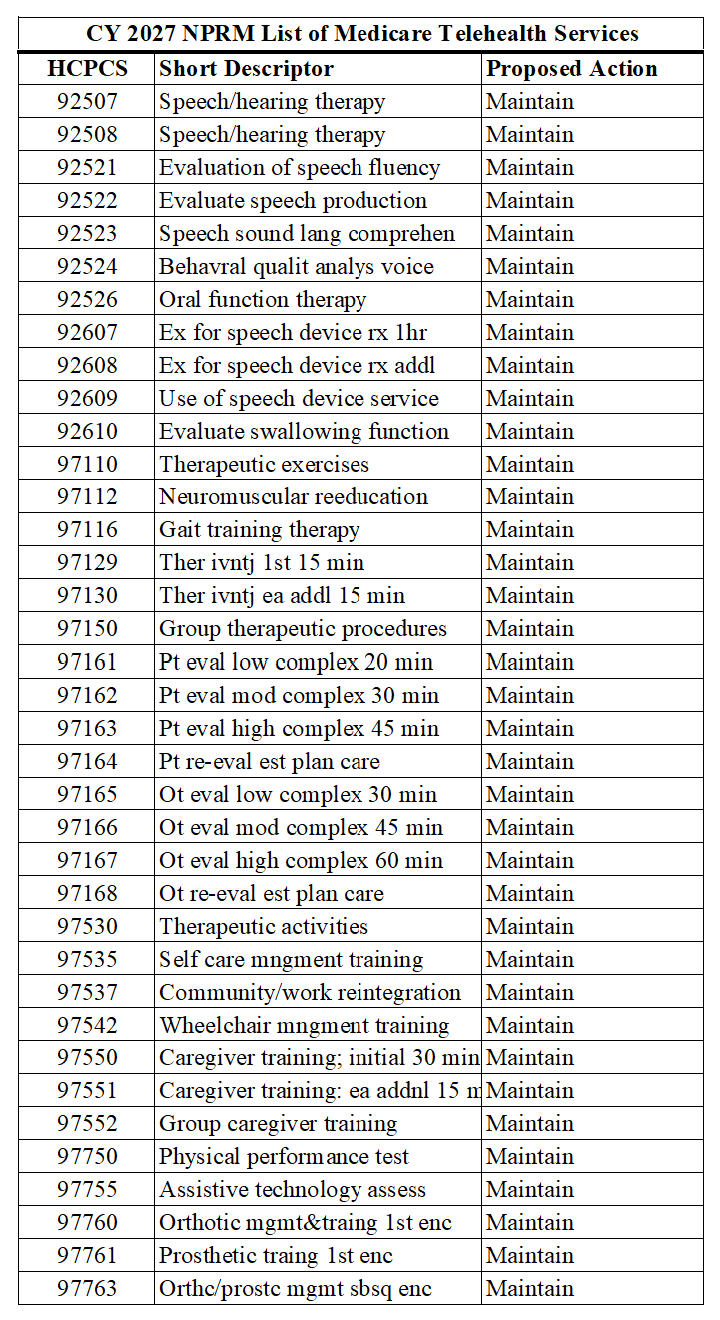
The Proposed Rule included an updated list of Telehealth CPT Codes for CY2027. Below is the link to the list of acceptable codes, as well as a snapshot of the CPT Codes used in SNF therapy. Only codes from the list can be provided via telehealth.
CY 2027 PFS Proposed Rule List of Telehealth Services
4. Changes to Therapy-Used CPT Codes
Speech-Language Pathology Codes
Speech has a big change headed their way for 1/1/27! Long-time code 92507, “Treatment of speech, language, voice, communication and/or auditory processing disorders,” will be replaced with 5 new sets of more specific coding options, specifically, to report fluency disorder, speech sound production disorder, language comprehension and expression disorder, speech sound production disorder and language comprehension and expression disorder, and voice, upper airway dysfunction and/or resonance disorders.
What are the new codes?
Each pair of includes a code for the initial 30 minutes of 1-1 treatment, and an add-on code for each additional 15 minutes. The “x” values will be replaced with numbers in the Final Rule.
- 92x0x Treatment of fluency disorder (e.g., stuttering and cluttering), direct (one-on-one) patient contact; initial 30 minutes
- 92x1x each additional 15 minutes
- 92x2x Treatment of speech sound production disorder (e.g., articulation, phonological process, apraxia, dysarthria), direct (one-on-one) patient contact; initial 30 minutes
- 92x3x each additional 15 minutes
- 92x4x Treatment of language comprehension and expression disorder (e.g., receptive and expressive language), direct (one-on-one) patient contact; initial 30 minutes
- 92x5x each additional 15 minutes
- 92x6x Treatment of speech sound production disorder AND language comprehension and expression disorder, direct (one-on-one) patient contact; initial 30 minutes *NOTE COMBO
- 92x7x each additional 15 minutes
- 92x8x Treatment of voice, upper airway dysfunction, and/or resonance disorders, direct (one-on-one) patient contact; initial 30 minutes
- 92x9x each additional 15 minutes
Existing CPT Code 92508 (Treatment of speech, language, voice, communication, and/or auditory processing disorder, group, 2 or more individuals) will remain as is.
The Proposed Rule states the new codes will be designated as “always therapy” which indicates they can only be billed when a therapy plan of care is in place. The main code of each pair (initial 30 minutes) will be subject to the Multiple Procedure Payment Reduction (MPPR) and the add-on 15 minute codes will be excluded.
ASHA.org is the go-to resource for details about the Speech Code changes, and they do a fantastic job of outlining the changes to come. Visit there site to see coding examples using the new Speech Codes. https://www.asha.org/practice/reimbursement/coding/new-speech-language-pathology-treatment-codes-replacing-92507/
Remote Therapeutic Monitoring (RTM) Codes
Remote Therapeutic Monitoring (RTM), per CMS, “was created to allow non-physician practitioners (therapists) to furnish and bill for collecting and monitoring non-physiological data, such as pain tolerance or exercise adherence.” RTM is under the umbrella of Remote Monitoring, as is Remote Patient Monitoring (RPM) which only applies to physician-type providers.
RTM is not designed for the SNF setting, as therapy staff is on site for any needed monitoring. However, because of the growth over the past few years, the Proposed Rule changes are included below, as is the updated list of RTM CPT codes.
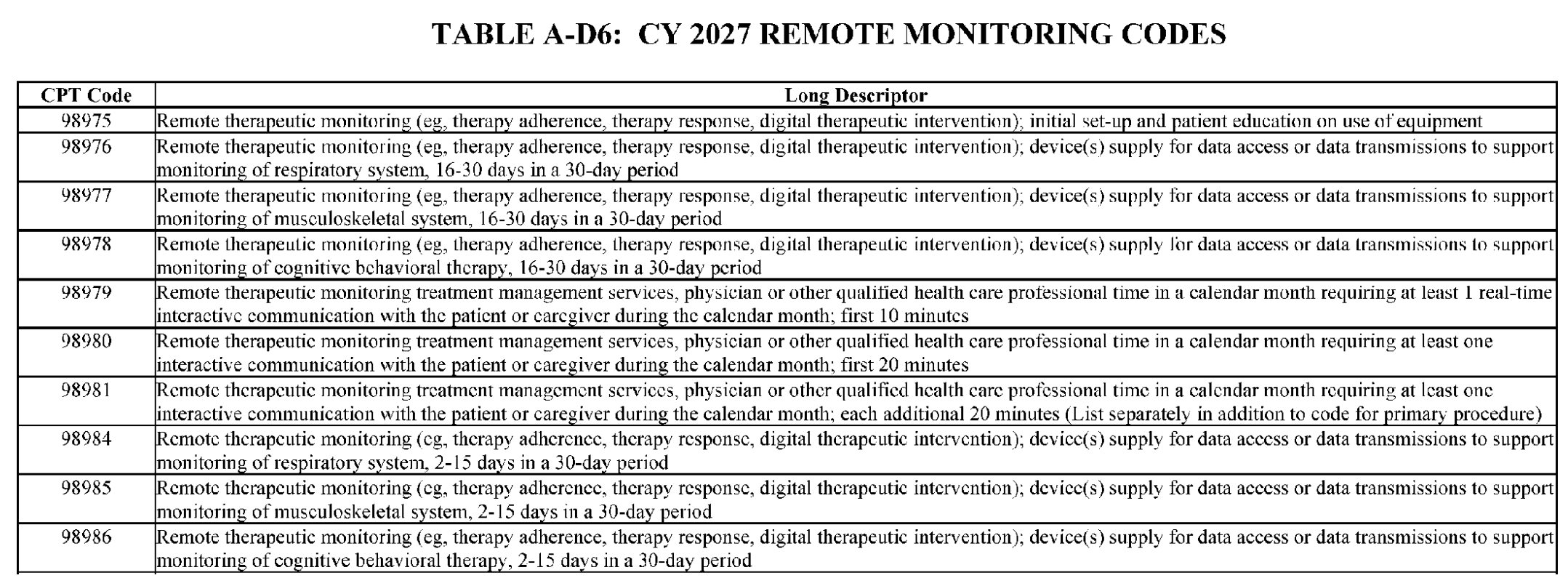
For FY2027, the Proposed Rule outlines new restrictions for RTM use. These restrictions are the result of a 2024 Office of Inspector General (OIG) Report on Remote Patient Monitoring (RPM), a similar “monitoring” service provided by physicians (not therapy professionals), that indicated improper service provision. RTM was not included in the OIG Report study, though CMS has decided to tighten things up just in case.
The Proposed Rule adds the following to RTM Code usage:
- Furnished only to established patients, meaning an assessment has already been performed prior to ordering RTM services
- The initiating visit would also ensure the billing practitioner assesses the beneficiary to determine clinical appropriateness of RTM and provide an opportunity to obtain the required beneficiary consent to receive RTM services.
- RTM services must be initiated by the billing practitioner during a face to-face (in-person or telehealth) visit where RTM is discussed. If RTM is not discussed, that visit cannot count as the initiating visit for RTM.
- Payment for RTM services only when furnished by clinical staff directly employed by the practice, and not outsourcing to third-party companies. [There is no mention in the Rule about institutional providers [SNF] that use contracted therapy staff.]
The Future of CPT Code Billing?
A large focus of the Proposed Rule was CPT Coding change, including not only making some modifications to how reimbursement for each code is structured, but also asking for formal feedback through the Request for Information process to gain provider input on alternatives to CPT Code use for Part B billing. This is an indicator that big changes may be coming down the road to the methodology of Part B billing! The Final Rule will provide more information once submitted comments are analyzed.Tuck that thought away for now as nothing is happening beyond what has been discussed above.
Important Links + Resources
Here are all the resources needed to dig deeper…
Final Rule – Federal Register Version | PDF Version
Rule Home Page (Includes links to all tables)
In Summary
As we await the Final Rule late next month, we can digest the proposed changes:
- Overall rate decrease of 1.68%, with limited impact for CPT Codes used by therapy
- KX Modifier Threshold of $2,540 for PT/SLP and $2,540 for OT
- $3,000 Manual Medical Review Threshold
- Therapy-provided telehealth allowable through 12/31/27
- Loss of 1 Speech CPT Code and gain of 5 new pairs of CPT Codes
- Extra conditions placed on use of RTM CPT Codes
CMS is accepting comments on the Proposed Rule through September 14, 2026 at this link: .https://www.regulations.gov/docket/CMS-2026-2377
As always, if you have any questions about the information or how it will impact you, send them to us here: Just Ask Q&A
In Your Corner,
Dolores
Dolores Montero, PT, DPT, RAC-CT, RAC-CTA
SNF Therapy & MDS Resource Team
MonteroTherapyServices.com