
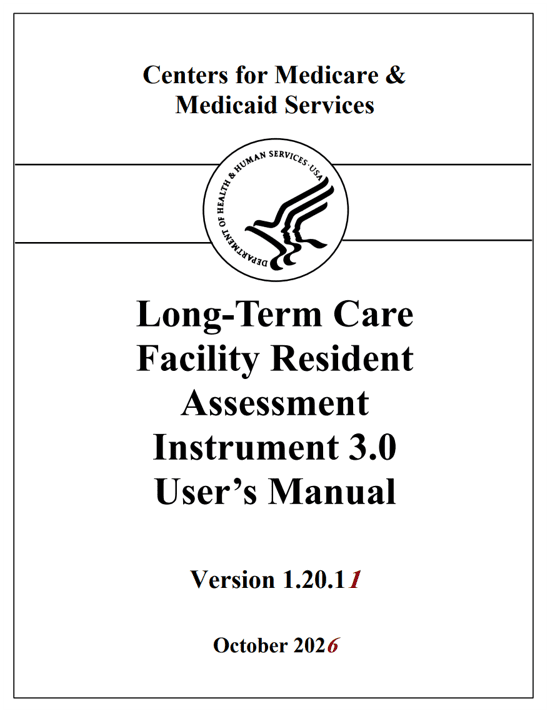
The updated RAI Manual released by CMS on 9/17/26 identified multiple minor refinements and clarifications to many sections of the MDS. Though there were no new questions added or removed, the refinements and clarifications made will have an impact on coding, documentation and current processes.
If there are no new MDS items [questions], how can refinements or clarifications change our practice?
Anytime updates are made to the Steps for Assessment or Coding Tips sections for a particular item, there is a potential impact on our process.
For example, one new clarification with the BIMS will change our process, as the Manual now instructs that if more than 1 BIMS was completed in the lookback, the BIMS closest to the ARD must be used.
Each major MDS change is reviewed below. If you are a visual learner and need to see the changes, there are 2 options:
1. Scroll the RAI Manual for Changes
Scroll through the new RAI Manual and observe any TEXT IN RED to indicate additions made. This is recommended for those less familiar with the Manual structure and content, as you will be able to use the surrounding information to help understand the changes.
The only downside (other than scrolling through 907 pages) is that text that has been removed from the Manual does not show. Only text additions show in red.
Here is the link to the new RAI Manual for 10/1/26 – v1.20.11:
2. Review the Manual Track Changes
A great way to review all the items added and removed from the updated Manual is to review the Track Changes. Track Changes are actually part of the Manual and can be found starting on page 864 in the above link.
Track Changes follow the structure of the Manual and indicate each piece of content that was altered, either by striking through deleted text or highlighting new text.
Here is the link to the Track Changes section of the Manual.
If you are new at this, consider using both options above side by side in your review so you can get the full effect, as the track changes alone do not provide context to the changes. If you’ve been at this for a bit, the track changes will give you what you need.
Now either go independently explore the suggestions above….
…….or continue on here to explore the key changes.
Key Manual Changes for 10/1/26
Chapter 2.3 “Responsibilities of Nursing Homes for Completing Assessments”
This section discusses when the RAI process is required. The “Resident Transfers” section was expanded into a new category “Resident Transfers During a Public Health Emergency.” Wording was clarified to state that if a PHE is declared, CMS will identify requirements at that time (ie: waiver use, what will be waived, etc.)
Chapter 3: Introduction
This is the section that reviews each MDS item 1-by-1, and opens with a new bold statement shown below that clearly states MDS items must be coded according to CMS item definitions (what the RAI Manual says), and that other payers or state entities cannot modify or add to the definitions or coding instructions. Part of this language was also added to Chapter 2 under Section S (State Sections), though clearly stated here.
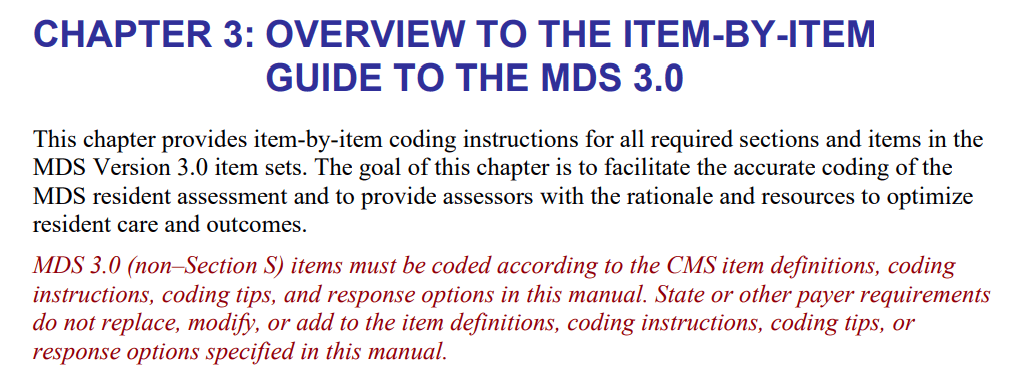
Keep this language handy for appeals if payors or State Medicaid reviewers are requesting documentation or any additional qualifiers to code specific items. It may also come in handy on state survey if your SNF is being asked to provide documentation that is not required for coding.
For example, the RAI Manual does not require a physician’s order to code item J1100C “Short of breath while lying flat,” therefore a denial cannot stem from this missing order.
Chapter 3: A1005 Ethnicity and A1010 Race
These items have new “Steps for Assessment” that will change the workflow, not the content. These items can now be asked on admission and annually thereafter, allowing for prior responses to be coded in between. Complete on admission by asking the resident the questions. The responses can be coded on subsequent assessments, and track the year mark so the resident can be asked again.
Chapter 3: The Brief Interview for Mental Status (BIMS)
The BIMS had 2 major wording changes that will change practice. First, the Manual removed the wording that the BIMS was to be completed, preferably, close to the ARD. Then new wording was added to clarify how to proceed with coding if more than 1 BIMS was completed.
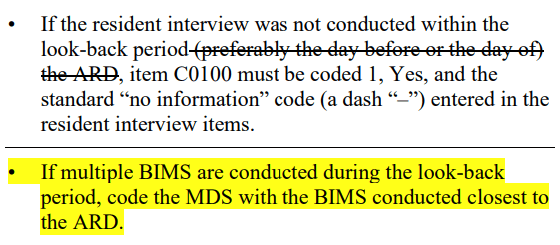
Make sure your therapy and MDS teams are aware of this change and plan accordingly. This will be a major change for some sites.
Chapter 3: D0150 Resident Mood Interview (PHQ)
Instructions for the PHQ changed to mirror the BIMS change above.

Chapter 3: J1100 Shortness of Breath
The Steps for Assessment was modified to add clarification that a resident reporting avoiding an activity (ie: lying flat) due to shortness of breath, is not required to perform that activity. Item #5 below was added.
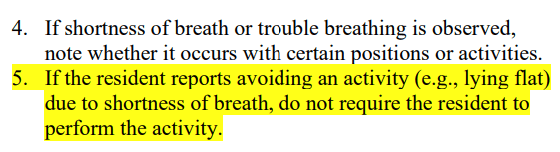
This is confirmation that the assessment of SOB lying flat does not require observing the resident to be placed in the position to “prove” the deficit if the resident reports breathing difficulty.
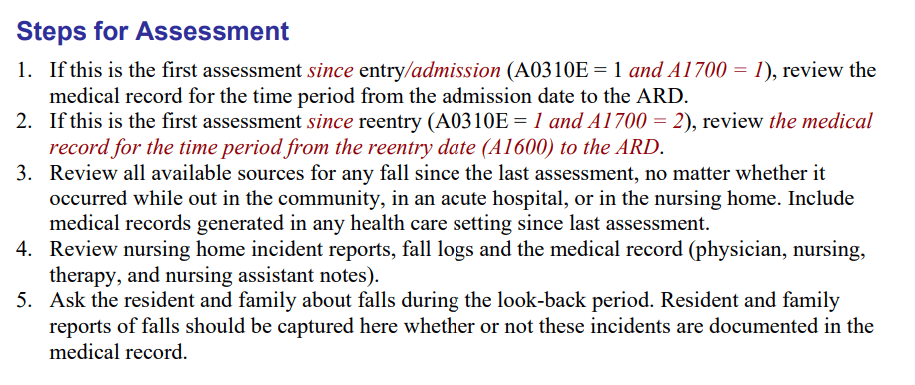
Chapter 3: J1800 Falls Since Admission/Entry or Reentry or Prior Assessment (OBRA or Scheduled PPS), whichever is more recent
The Steps for Assessment for Falls was clarified for admission and reentry as follows:
Chapter 3: Section M – Skin Conditions
There were multiple wording additions speckled throughout Section M for clarification.
M0201 Unhealed Pressure Ulcers:

M0300 Current Number of Unhealed Pressure Ulcers/Injuries at Each Stage
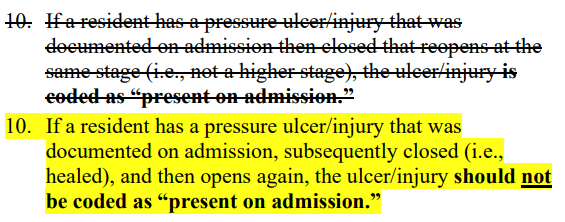
M1040C Other Open Lesion(s) on Foot
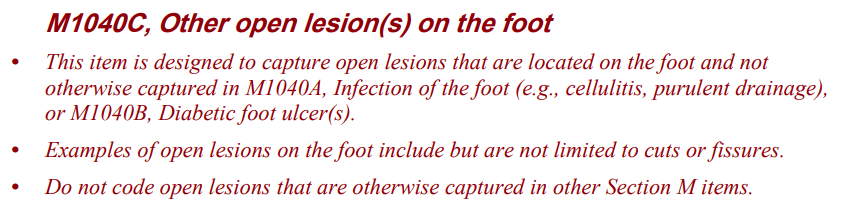
M1040E, Surgical wound(s)

M1200E, Pressure ulcer/injury care

M1200F Surgical Wound Care
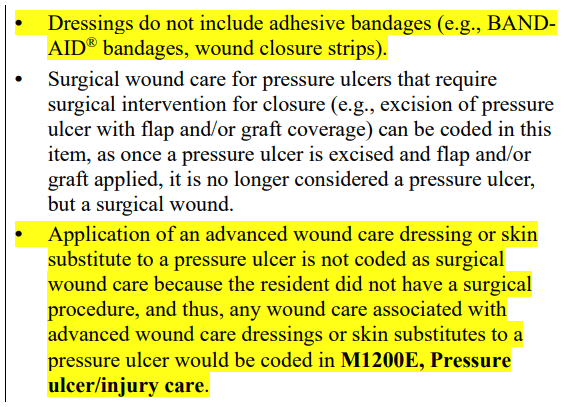
M1200I Application of dressings to the feet (with or without topical medications)

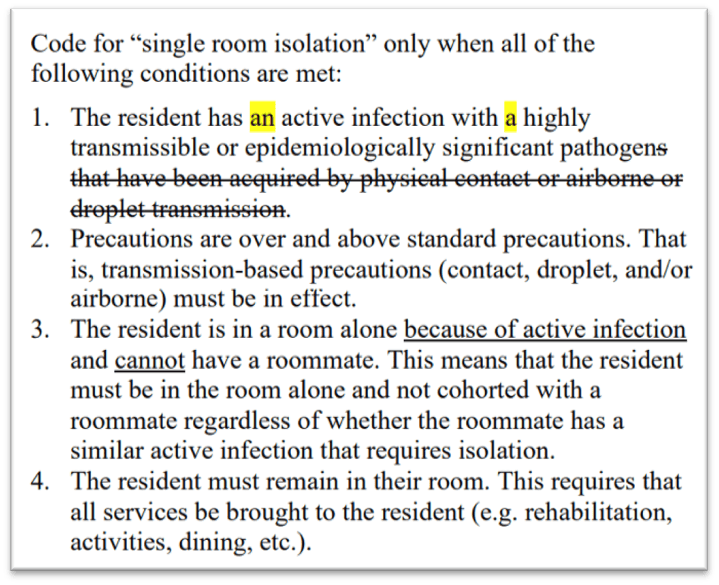
Chapter 3: Section O – O0110M1, Isolation or Quarantine for Active Infectious Disease
This section deleted partial language in the 4 requirements for “single room isolation” regarding how the infection was acquired. Here is what the change looks like:
Section O: Therapy Services – O0390
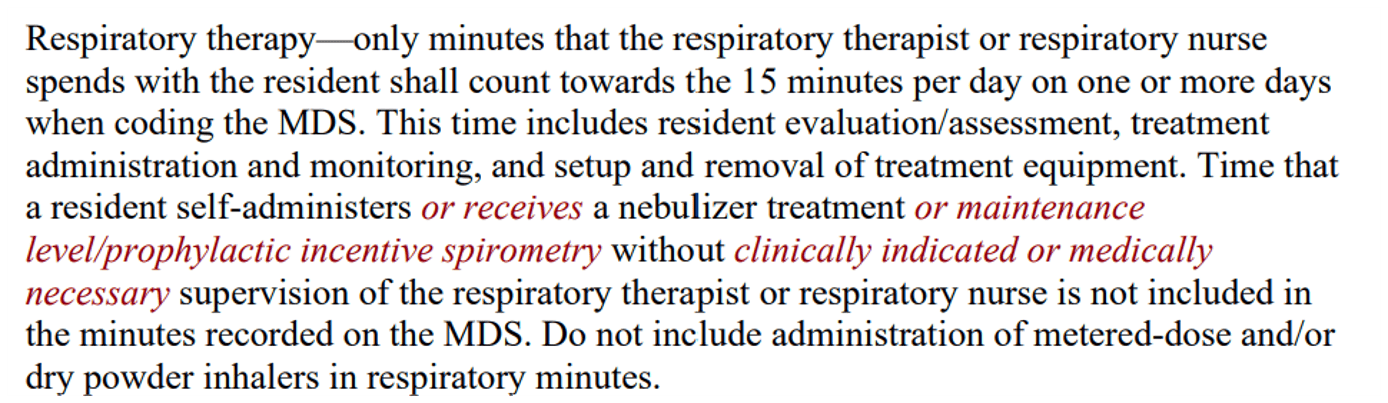
Changes in this section focus on Respiratory Therapy, making the distinction between routine maintenance level services and skilled services. The language in the RT section now models what has been in the PT/OT/Speech section for years. Coding RT on the MDS requires documentation to support “skilled services” and to distinguish these from maintenance.
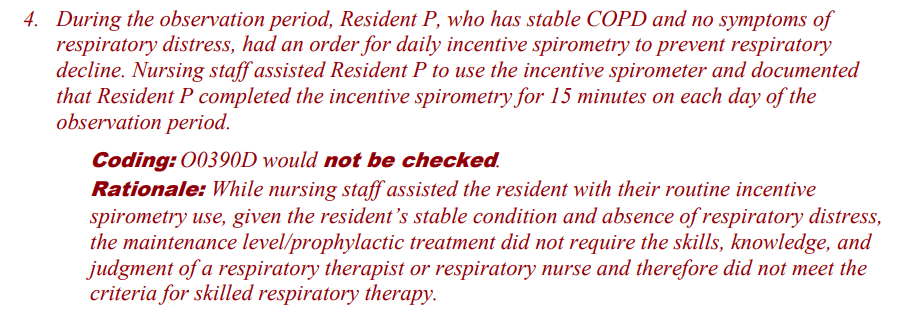
The Manual also added a new coding example for RT that is a must see.
Chapter 6: PDPM Worksheet
Chapter 6 is the Medicare PPS and PDPM Section, including the PDPM Calculation Worksheet. The only additions made to this section were wording swaps from “depression” to “signs and symptoms of depression” in reference to the Mood Interview, and added text under Restorative Nursing on the PDPM Worksheet added the reminder that coding “toileting programs do not require documentation of days/minutes” (unlike the other Restorative Nursing Program items. These changes will not impact practice.
Consider Yourself Up to Date!
If you have any questions, send them to our Just Ask Q&A Team and we will get your questions answered.
Thank you for all you are doing to provide the best care to the geriatric population!
In your corner,
Dolores
Dolores Montero, PT, DPT, RAC-CT, RAC-CTA
President | Montero Therapy & MDS Resource Team
MonteroTherapyServices.com